Note: This report covers the period between October 1st and December 31st. Approximations are made if a transaction spans multiple quarters. Values are in USD unless specified otherwise.
Table of Contents
A Message from the Streamr Governance Council
The year 2025 has been monumentally important for the project. Not only has the project unlocked a new chapter by shifting its focus from protocol infrastructure (which is now incredibly mature!) to the application layer, the project has also identified a path to sustainability and a go-to-market strategy revolving around live video streaming.
As part of the journey towards those goals, the project delivered an experimental application, StreamrTV, to test the technical concept as well as user interest in the wild. With learnings from that, the project has sharpened its product vision and is currently well on its way towards delivering privacy and security oriented, multi-broadcast (aka ‘many-to-many’) streaming in a new iteration of the video application, now to be known as just Streamr.
While the overall token markets have been deeply pessimistic throughout 2025, the project has so far been able to fund itself via the SIP-22 and SIP-24 token packages while simultaneously adjusting the burn rate and working towards unlocking revenue-based sustainability (i.e. moving away from token emissions), by the end of 2026 thanks to the mainstream video product.
Key achievements
- Q4 saw us advancing the Streamr App towards a next-generation video conferencing solution for remote teams.
- Following internal evaluation and prototyping, the project aligned on video conferencing as the core use case for the Streamr App Beta.
- A working internal version was developed and tested during the period, providing the team with confidence in the technical feasibility and product direction.
- This represents the first successful implementation of ‘multi-broadcast’ live video streaming within the Streamr stack, marking a significant technical milestone and an important step forward for the project.
- Live video streaming integrated with Streamr Network tokenomics
- Live video streams are now supported by the decentralised Streamr Network Operator nodes, that automatically join and support live video streams on Streamr App. In return, Operator Nodes earn DATA for supporting live video delivery, with staking and rewards handled via the AutoStaker system built in Q3.
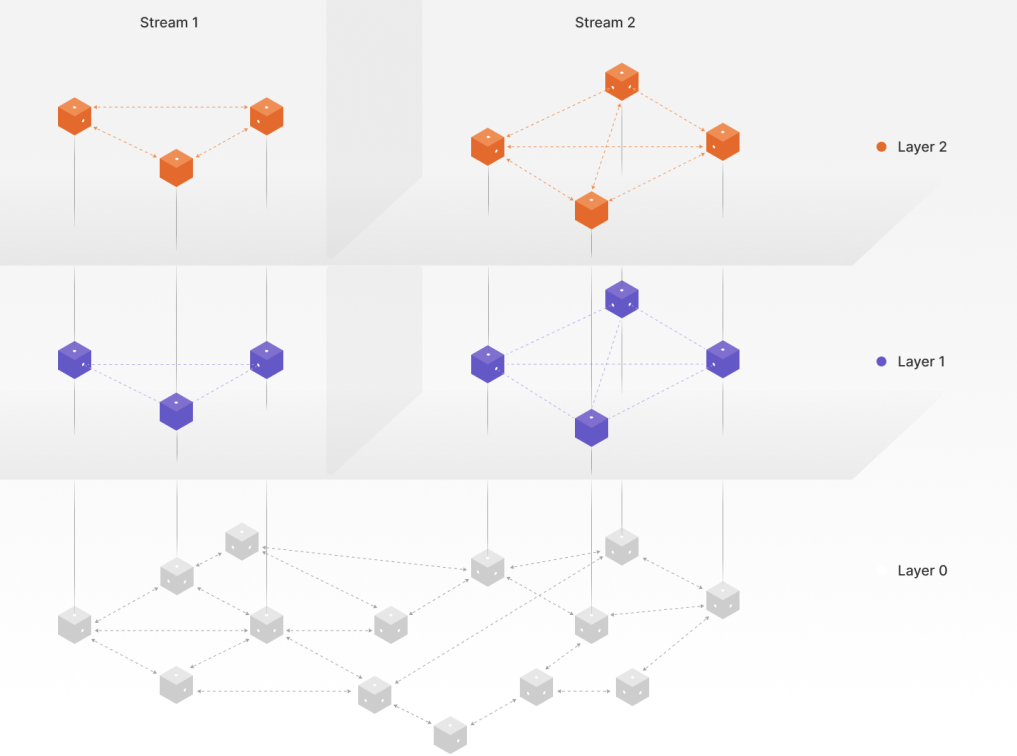
- A new network graph view was introduced to visualise which Operators are connected to a given stream, improving transparency and observability of network participation.
- This integration represents a major architectural advancement, directly linking application-layer demand side with the network’s supply side of Operator nodes and DATA token incentives – key to supporting the token ecosystem over the long term.
- In addition, this architecture unlocks core Streamr Beta features; it enables privacy benefits through IP address obfuscation, improves resilience for video streaming under demanding network conditions, and supports bandwidth optimisation and efficiency.
Implemented video recording functionality
A video recording feature was added, enabling broadcasts to be recorded and made available for later viewing. This improves the overall user experience and supports use cases where live participation is not possible, while increasing the long-term visibility and utility of streamed content.
Project financials
- Approximately 7.5M DATA tokens were distributed to community Node Operators.
- $314,966.6 USD was raised from the sale of 39,078,781.1 DATA tokens at an average price of $0.00806 per token for project development and growth.
- 401,003.3 DATA generated in network protocol fees this quarter.
- At the end of Q4 the project’s cash reserve was approximately $490,000. This is up from the reported $440,000 in Q3. DATA selling remained cautious in Q4 due to the adverse markets and amounted to less than the expenses. This would have otherwise reduced the cash reserve, but there were also some corrections to earlier expense allocations in 2025, and the resulting total actually increased from the previous quarter’s reported amount, which didn’t include said corrections.
- Remaining tokens from the previous governance checkpoint (SIP-22) were depleted during the quarter, and a subsequent package (SIP-24) was granted, with around 91M DATA remaining at the end of the year.
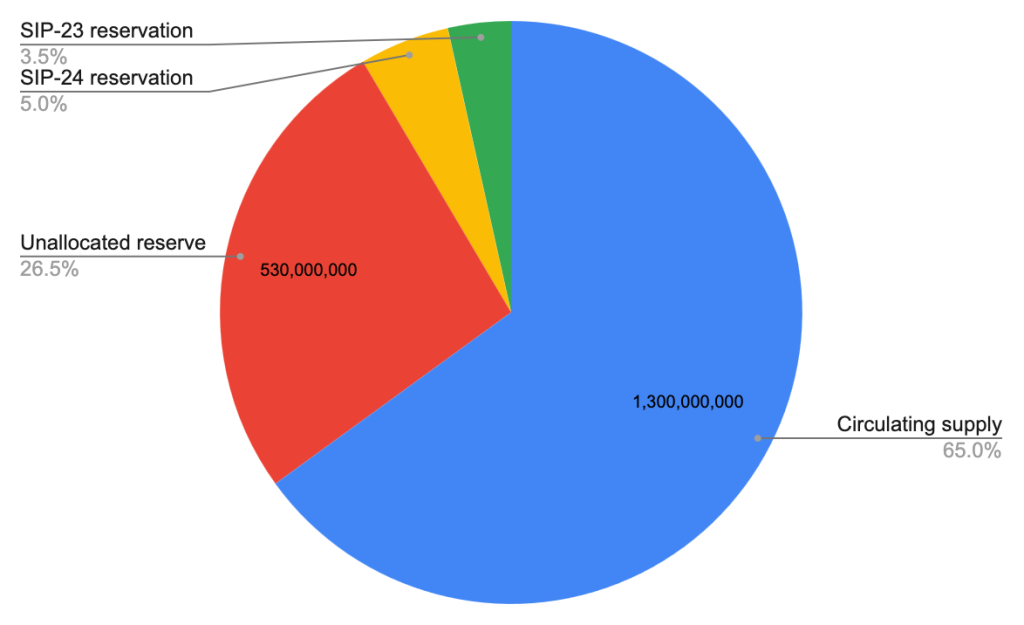
- The circulating supply stands at around 1.3B DATA. The project’s token reserve is approximately 700M DATA. After deducting the reservations for SIP-23 and SIP-24, there remains 530M of unallocated DATA in the reserve, to be potentially allocated later via governance votes:
Governance checkpoint projections
Each unlock from the project’s token reserve is structured to conclude with a governance checkpoint, providing token holders with a regular opportunity to assess progress and align future funding decisions with project milestones. These checkpoints will trigger a vote (SIP, or Streamr Improvement Proposal) to unlock the next batch of tokens for the core team to develop and market the Streamr project.
By tracking our average monthly spend against the DATA token price, we estimate that the next funding package SIP will arrive in mid-2026. Changes in the token price, token liquidity, team spending, and the utilization of the project’s cash reserves can extend or contract the timeline.
Project expenses
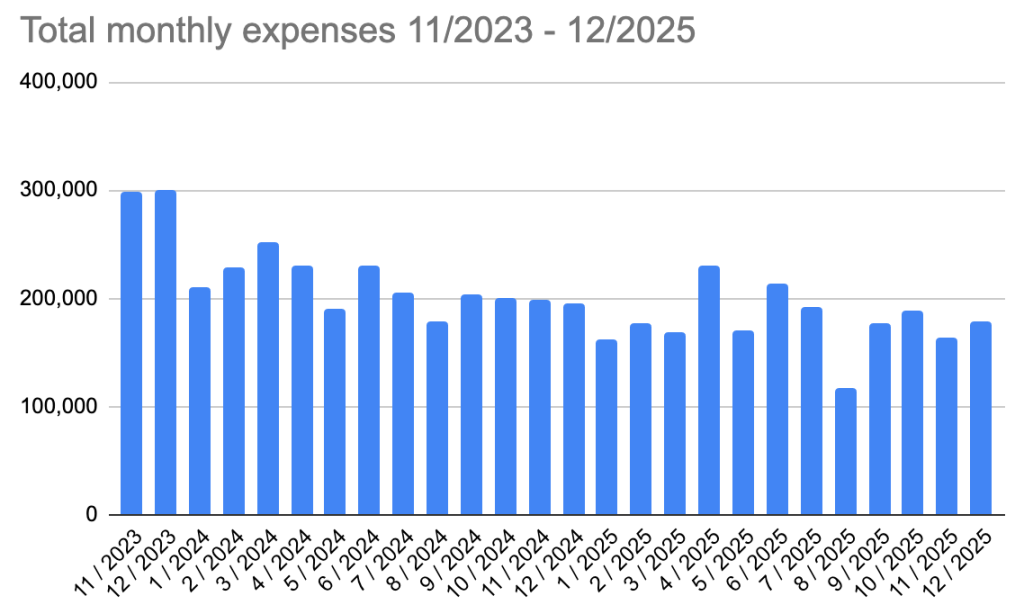
The overall spending in Q4 was $532k, slightly up from the Q3 figure of $499k. This is largely due to summer holidays reducing the burn observed in Q3.
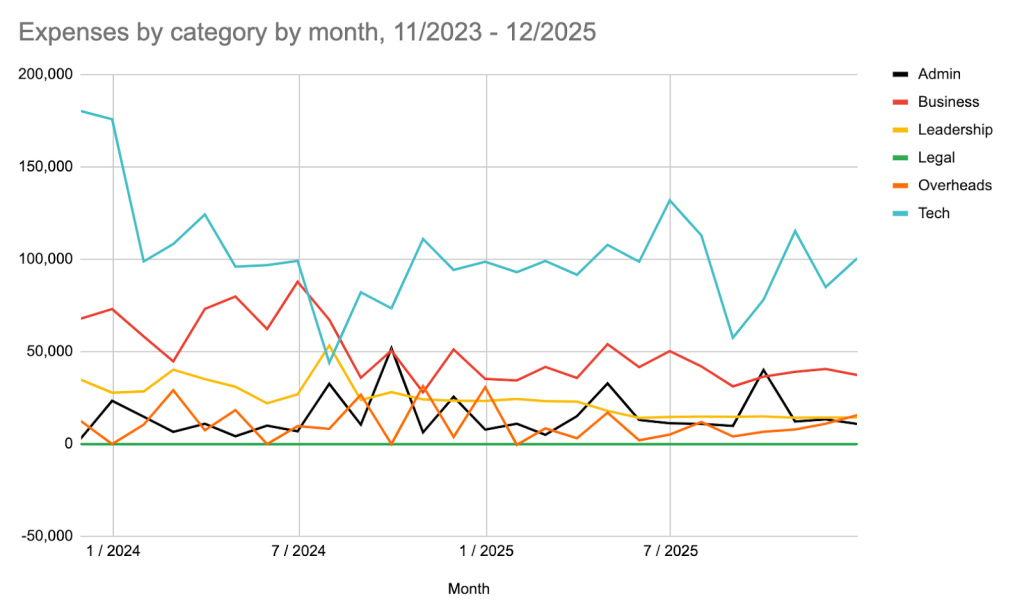
While the project has managed to adjust its burn to prevailing market conditions and funding, cost-efficiency remains one of our strategic focus areas in order to minimize token supply inflation and improve project sustainability. The project is targeting to further reduce the monthly burn to sub-$100k level by the end of Q1/2026.
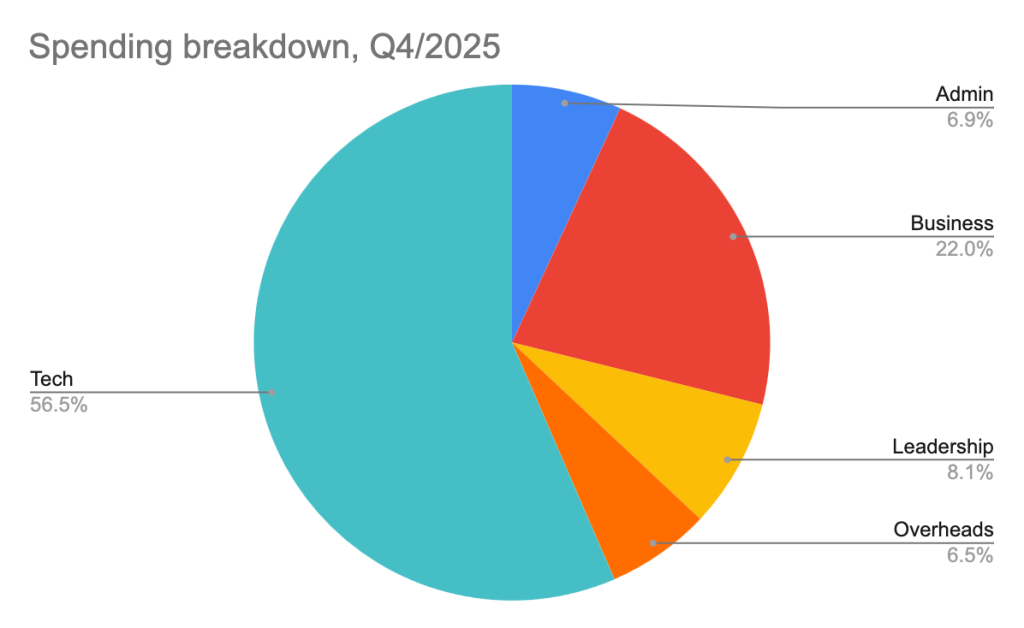
| Month | Admin | Business | Leadership | Legal | Overheads | Tech |
| 10 / 2025 | 12,271 | 39,097 | 14,295 | 0 | 7,925 | 115,218 |
| 11 / 2025 | 13,398 | 40,634 | 14,443 | 0 | 11,050 | 84,963 |
| 12 / 2025 | 10,971 | 37,369 | 14,428 | 0 | 15,685 | 100,552 |
| Total | 36,640 | 112,185 | 43,165 | 0 | 34,660 | 280,047 |
Spending category contents:
Admin: HR, accounting, bookkeeping, offices, utilities, financial services.
Business: Bizdev & marketing team salaries, ad and campaign expenses, events.
Leadership: Project leadership salaries.
Legal: Legal and compliance fees.
Overheads: Insurance, mandatory pension payments, taxes.
Tech: Developer salaries, product UX/UI designers, software licenses and cloud services.
Total project expenses in Q4/2025: $532,299 USD (average $177,433/month)
Locked/staked supply
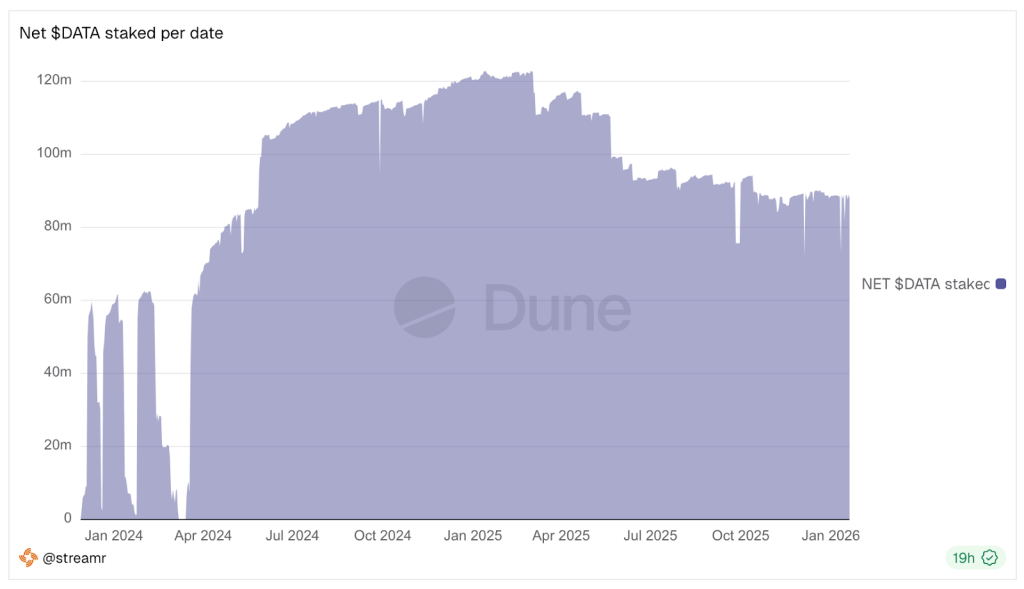
The amount of locked tokens has decreased slightly from 97M to 93.4M DATA representing a -3.7% change in the amount of tokens locked in Operators and Sponsorships from the start of the quarter to the end of the quarter.
Node Operators
Approximately 7.5M DATA tokens have been issued (approved in SIP-14) to node operators this quarter through Streamr Sponsorships to help secure the streaming network.
| Issuance event | Start date | Static sponsorships (DATA) | Dynamic sponsorships (DATA) | Total Issuance (DATA) |
| 22 | 2025-10-03 | 2,300,000 | 200,000 | 2,500,000 |
| 23 | 2025-11-05 | 2,300,000 | 200,000 | 2,500,000 |
| 24 | 2025-12-08 | 2,000,000 | 500,000 | 2,500,000 |
A growing allocation of operator rewards are distributed via dynamic sponsorships created by Streamr App/StreamrTV. They are shorter in duration and appear frequently, as they are created when users stream on the application. Operators can leverage the autostaker to automatically react to new sponsorships and capture rewards from dynamically generated sponsorships.
Active (staked) node operators were 175 at the start of the quarter, dropping to 159 by the end of the quarter – a 9% drop.
Token Disclosures
The company Streamr Network AG owns 139,309,088 DATA. The company is owned and controlled by project founders and early investors.
While the company has the right to participate in governance voting just like any other token holder, since May 2021 the company has voluntarily abstained from voting to avoid dominating the votes and let smaller token holders’ voices be better heard.
DATA Ecosystem fund
The Data Fund supports projects and individuals in building with Streamr, as well as selected growth and marketing campaigns. Fund balance: 10.2M DATA.
| Date | Description | Amount | Transaction hash |
| 24 / 10 / 2025 | Growth support: contests, quick reaction promotions, influencer campaigns | 500,000 (DATA) | https://etherscan.io/tx/0x8f6cfbde12e23706876ae52aec61fb726795d4db95b7fb97acf663078b012f85 |
| 20 / 11 / 2025 | Payment to Murat Dogan for node-datachannel one year sponsorship | 167,000 (DATA | https://polygonscan.com/tx/0xb8d41a605a0d3261c1a387af04e66a0c36a9566f579db24ab5f4f68fac0c67d8 |
| 20 / 11 / 2025 | Growth support: contests, quick reaction promotions, influencer campaigns | 300,000 (DATA) | https://polygonscan.com/tx/0xb2194481a357d9d849807a78e4520f19296cdf7f9229b6f3b538a4603dd63e6e |
Governance updates
There were three governance proposals this quarter, two of which were approved by the token holders:
| ID | Outcome | Description |
| SIP-23 | Rejected | A token incentive program for certain roles in the operational project leadership was proposed, where token bonuses are allocated from the reserve and unlocked if certain token price levels are reached. Many voters found room for improvement in the terms governing earning the bonuses, and the proposal was rejected. A subsequent, edited version was passed as SIP-23 (v2). |
| SIP-23 (v2) | Approved | This proposal set forth an improved version of the token incentive program first introduced as SIP-23. This version of the proposal had much wider backing from the community and was approved. |
| SIP-24 | Approved | This proposal was a governance checkpoint, a funding checkpoint to check on project progress and set goals for the next chunk of funding. The decision allocated 100M DATA from the reserve to be spent towards developing the Streamr App Beta. |
GitHub Activity
The development focus at the moment is on Streamr App, which involves some non-public code repositories. For visibility into the non-public work, we include this section to display the development activity surrounding private repositories.

The heaviest development activity is currently in the repository streamrtv, which is a monorepo containing the various modules of the Streamr App. There is also ongoing development in the network repository – which is public – containing the main code for components of the Streamr Network, such as the Streamr Node and Streamr SDK.
Risks and Challenges
Adoption
Following the launch of MVP2 in Q3, the focus in Q4 shifted towards a deeper assessment of the market opportunity for the Streamr App. This work combined analysis of Streamr’s core technology capabilities and early marketing data with broader research into market size, category dynamics, and the competitive landscape. The objective was to identify where the project can deliver clear and defensible differentiation.
Based on this analysis, the Council agreed to focus the Streamr App on next-generation video conferencing. The intended direction is a secure and privacy-preserving video communication platform capable of supporting multiple use cases, with privacy-conscious entrepreneurs and teams identified as the initial bullseye customer profile. Conceptually, this can be understood as a video conferencing “super app”, leveraging Streamr’s decentralised infrastructure to address limitations observed in existing products.
As a result of this strategic refocus, Q4 did not prioritise active adoption or growth initiatives. Instead, efforts were concentrated on building and refining a beta version of the product, as development transitions from one-to-many streaming (MVP2) to many-to-many communication in the Streamr App Beta. The beta launch is planned for March 1st 2026, at which point structured growth and go-to-market activities will commence.
Technical challenges
As foreseen in the Q3 transparency report, the main technical challenge faced during Q4 was the implementation of multi-broadcast video streaming in the Streamr App core. This challenge was successfully overcome, and we were able to develop a preliminary version of a Streamr-based teleconferencing web-app. The main technical challenge for Q1 of 2026 is making the app feature-complete and production-ready (bug-free, tested to work on all platforms).
Security vulnerabilities or incidents
There have been no consequential security incidents.
Legal or regulatory updates
There have been no consequential legal or regulatory incidences.
If you have any questions about this transparency report, feel free to ask in the governance channel on the Streamr Discord.